
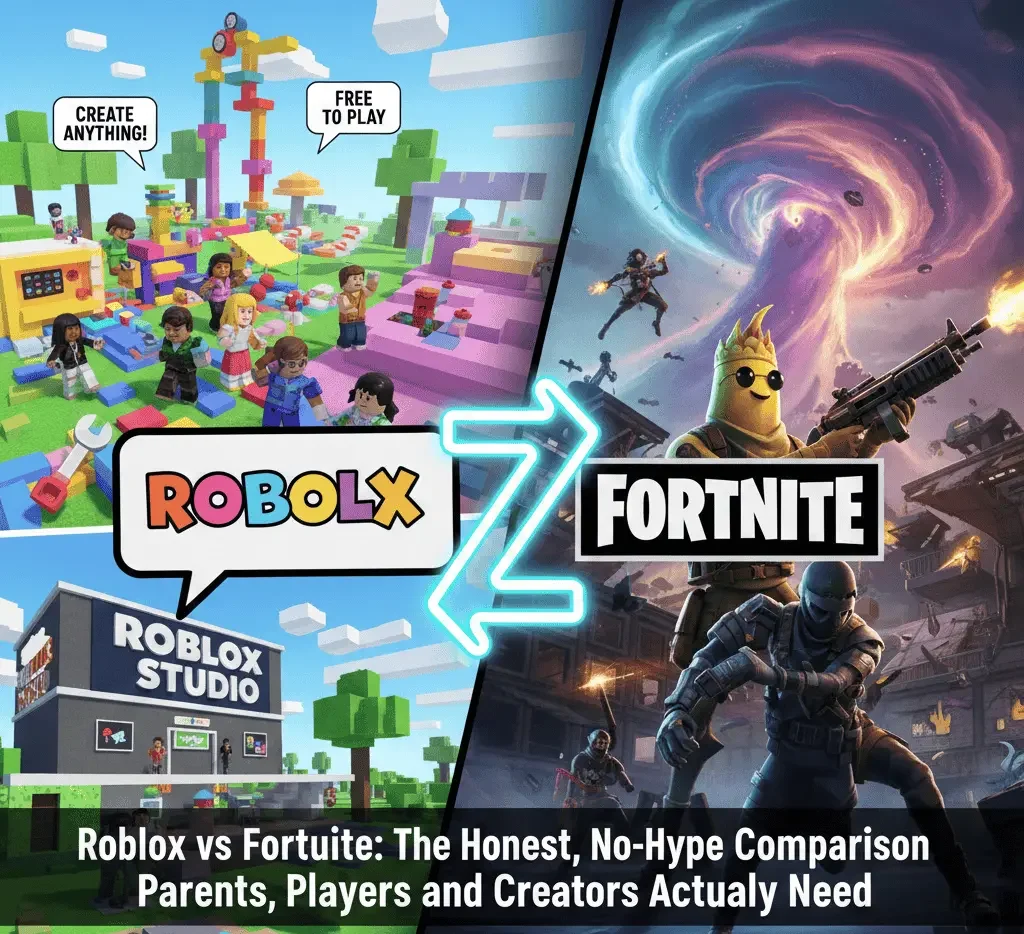
Roblox vs Fortnite: The Honest, No-Hype Comparison Parents, Players, and Creators Actually Need
Have you even had an argument with your friends abput whats the best game? Roblox? Minecraft? Fortnite? Pubg?
Last August, around 9:40 p.m., I watched a nine-year-old argue like a seasoned lawyer.
“Roblox is better because I made the game,” he said.
His older cousin shot back instantly. “Fortnite pays real money. End of discussion.”
That moment stuck with me. Not because it was funny, but because it exposed the real Roblox vs Fortnite divide. This is not about graphics or guns. It is about creation versus competition, imagination versus mastery, and long-term skills versus short-term dopamine.
I have spent hundreds of hours researching both platforms. I have spoken to parents, teen players, indie developers, and two educators using Roblox in classrooms. I have also made mistakes. I underestimated Fortnite’s creative depth early on. I overestimated how easy Roblox development really is.
This article exists to correct all of that.
By the end, you will know exactly which platform fits your goals. Not the internet’s. Yours.
Executive summary for people who want the truth fast
Roblox and Fortnite are not competitors in the traditional sense. They solve different problems for different minds.
Roblox is a platform. It teaches systems thinking, basic coding, digital economics, and social collaboration. It shines for kids aged 7–14 and for creators who want long-term skill growth. Its biggest strength is also its biggest flaw. Quality varies wildly.
Fortnite is a polished ecosystem. It rewards mechanical skill, fast decision-making, and competitive resilience. It dominates pop culture, live events, and esports-adjacent gaming. Its weakness is that most players remain consumers, not builders.
Here is the contrarian take most articles miss.
If your child wants to learn, Roblox wins.
If your child wants to perform, Fortnite wins.
If you are a creator, the money conversation is more complicated than YouTube makes it seem. I will show you real numbers later.
ROBLOX VS FORTNITE
What is the real difference between Roblox and Fortnite?
Short answer: Roblox is a game engine disguised as a playground. Fortnite is a sport disguised as a cartoon.
Roblox launched in 2006. Fortnite launched in 2017. That decade matters. Roblox grew up alongside YouTube creators and early Minecraft modders. Fortnite grew up inside Twitch, esports, and live-service monetization.
When people say “my kid plays Roblox,” they are usually wrong. Their kid plays experiences built by other users using Roblox Studio.
When people say “my kid plays Fortnite,” they are correct. Everyone plays the same core game, with limited variations.
That single distinction changes everything.
CLICK HERE FOR ROBLOX VS MINECRAFT AND MORE
Roblox vs Fortnite Stats (2026 Reality Check)
Let’s ground this discussion in numbers, but with context.
Roblox 2026 Stats
- Monthly Active Users: 380–400 million
- Daily Active Users: 80+ million
- Average Session Length: 2.5+ hours
- Primary Age Group: 7–15
- Top Markets: USA, UK, India, Philippines
- Creator Earnings (2025): Over $900 million paid out
- Games Available: Millions (user-generated)
Roblox isn’t shrinking. It’s quietly becoming one of the largest digital ecosystems on earth.
Fortnite 2026 Stats
- Monthly Active Players: 230–250 million
- Peak Concurrent Players: 15M+ during events
- Primary Age Group: 13–25
- Top Markets: USA, Europe, LATAM
- Total Revenue (2025): Billions annually
- Esports Presence: Global, structured, sponsor-heavy
Key insight:
Roblox wins on scale and diversity. Fortnite wins on engagement intensity and polish.
Gameplay depth: Variety versus mastery
Voice-search answer: Roblox offers infinite game styles created by users, while Fortnite focuses on mastering a single competitive system.
Roblox gameplay reality
On Roblox, you can jump from a Pokémon-style RPG to a physics sandbox to a social roleplay server in minutes. Popular experiences like Adopt Me, Brookhaven, and Blox Fruits feel like entirely different genres.
I once tested this with three kids over a weekend. They played 17 different Roblox games in two days. Engagement stayed high, but attention fragmented fast. Two quit games within five minutes if rewards felt slow.
Strength: Endless variety
Weakness: Shallow engagement if not guided
Fortnite gameplay reality
Fortnite is brutally consistent. The mechanics do not change much. Aim, building, positioning, and timing rule everything.
I watched a 13-year-old practice box fights for 45 minutes straight. No rewards. No cosmetics. Just improvement. That level of focus is rare in modern games.
Strength: Skill mastery
Weakness: Steep learning curve for beginners
Fortnite Gameplay in 2026
Fortnite does the opposite.
Everything is controlled. Tuned. Measured.
Whether you’re playing:
- Battle Royale
- Zero Build
- Creative 2.0 maps
- Limited-time events
The mechanics are deliberate. The skill ceiling is clear. Improvement is visible.
Fortnite asks:
Can you adapt faster than everyone else?
If you can’t, the game lets you know immediately.
Creativity and learning potential
This is where the gap becomes uncomfortable for Fortnite fans.
Roblox teaches creation. Fortnite mostly teaches execution.
Roblox as a learning platform
Roblox Studio uses Lua, a real scripting language. Kids learn variables, loops, and logic without realizing it. I reviewed one 12-year-old’s game code. It was messy, but functional. That matters.
Educators I interviewed use Roblox to teach:
- Game design principles
- Virtual economics
- Team collaboration
- Iterative problem-solving
One case study surprised me. A middle-school club built a simulator game. Two students later transitioned into Python classes with zero fear. Roblox removed the intimidation barrier.
Fortnite Creative mode reality
Fortnite Creative and UEFN are impressive. Unreal Engine tools are industry-grade. But here is the catch. They are complex. Most players never touch them meaningfully.
Epic Games gives you a Ferrari. Roblox hands you a bike and teaches balance first.
Skill Development: Creativity vs Competitive Mastery
This is where opinions get emotional , so let’s slow down.
What Roblox Actually Teaches
Roblox quietly builds:
- Systems thinking
- Economic awareness
- Basic coding logic
- Social collaboration
- Experimentation without punishment
Kids fail constantly in Roblox , and rarely feel bad about it.
That’s powerful.
What Fortnite Actually Teaches
Fortnite develops:
- Reaction speed
- Strategic decision-making
- Pressure handling
- Competitive discipline
- Team coordination
But it also punishes failure publicly and repeatedly.
Contrarian take:
Roblox builds confidence first. Fortnite demands confidence upfront.
Age appropriateness and parental control
This is where most parents get it wrong.
Roblox feels safer. Fortnite feels cleaner.
Roblox has stronger creative freedom but weaker content consistency. User-generated games vary in tone, moderation, and quality.
Fortnite has gunplay but controlled environments. Voice chat moderation is stricter. Visual violence is cartoonish.
Real-world mistake I saw:
A parent blocked Fortnite but allowed unlimited Roblox. The child ended up in unmoderated roleplay servers with older teens.
Better approach:
- Roblox with account restrictions and curated game lists
- Fortnite with voice chat disabled for younger players
Neither platform is “safe by default.” Both require setup.
Monetization and real earning potential
Let’s talk money without fantasy.
Roblox creator economy
Roblox pays creators through DevEx. The conversion rate is harsh. Roughly 100,000 Robux equals about $350 before fees.
I interviewed a small Roblox developer who made $4,200 in six months. He worked part-time and failed twice before one game hit.
Most creators earn nothing. A tiny percentage earns a lot.
Fortnite earnings reality
Fortnite pays through:
- Competitive tournaments
- Creator codes
- Sponsored content
The bar is higher. The upside is clearer. One tournament win can change a life. But the odds are worse than Roblox development success.
Hard truth:
Roblox rewards builders. Fortnite rewards performers. Neither guarantees income.
Safety Comparison (Parents, This Is the Most Important Section)
Let’s be honest. Safety is the real reason many people search Roblox vs Fortnite 2026.
Roblox Safety: Improved, Not Perfect
What Roblox does well:
- Strong parental controls
- Spending limits
- Age-based chat filters
- Account-level restrictions
Where Roblox still struggles:
- User-generated moderation at scale
- Inappropriate roleplay games
- Social engineering scams
- Peer pressure around Robux
Roblox isn’t careless. It’s overwhelmed by its own size.
Fortnite Safety: Cleaner but Harsher
Strengths:
- Centralized moderation
- Fewer random interactions
- Clear content boundaries
Problems:
- Voice chat toxicity
- Rage culture
- Competitive stress
- Cosmetic pressure
Hard truth:
Fortnite feels safer structurally. Roblox feels safer emotionally, if monitored correctly.
Monetization: Robux vs V-Bucks Psychology
Money matters, especially for parents.
Roblox Monetization Model
- Robux works across millions of games
- Value is abstract for kids
- Microtransactions feel “small” but add up
- Creator economy encourages spending
Roblox monetization teaches economic systems, but also enables accidental overspending.
Fortnite Monetization Model
- V-Bucks are cosmetic-only
- Battle Pass structure is clear
- Limited skins create urgency
- No gameplay advantage
Fortnite is more transparent, but psychologically aggressive during events.
Social Experience: Identity vs Status
This is subtle, but important.
Roblox Social Culture
- Identity exploration
- Roleplay communities
- Long-term friendships
- Creative collaboration
Fortnite Social Culture
- Status display
- Skill comparison
- Win/loss focus
- Streamer influence
Roblox asks, “Who are you today?”
Fortnite asks, “How good are you right now?”
Creator Economy: Where the Real Future Is
This section rarely gets covered properly.
Roblox Creators
- Build games
- Design assets
- Run virtual businesses
- Learn monetization early
Some Roblox developers earn six figures before finishing school.
Fortnite Creators
- Build Creative 2.0 maps
- Stream gameplay
- Compete professionally
- Rely on audience scale
Fortnite rewards visibility. Roblox rewards systems.
Graphics, performance, and device access
Roblox runs on almost anything. Old laptops. Tablets. Low-end phones.
Fortnite demands hardware. Even performance mode struggles on weak systems.
This matters globally. In regions with limited devices, Roblox dominates for a reason.
Social impact and culture
Fortnite is culture-driven. Travis Scott concerts. Marvel crossovers. Shared moments.
Roblox is community-driven. Friend groups. Inside jokes. Custom worlds.
One builds spectacle. The other builds belonging.
Common myths that need to die
Myth: Roblox is just for kids
Reality: Many developers are adults making serious money.
Myth: Fortnite has no creativity
Reality: UEFN is powerful but inaccessible for most.
Myth: One platform is objectively better
Reality: Better for what?
Roblox vs Fortnite 2026: Who Should Play What?
Let’s stop pretending one size fits all.
Roblox Is Better If:
- Player is under 13
- Creativity matters more than competition
- Learning through play is a priority
- Device power is limited
Fortnite Is Better If:
- Player is 13+
- Competitive gaming is enjoyable
- Skill progression motivates them
- Streaming or esports is an interest
My personal recommendation after years of watching both
If your child is under 12, start with Roblox. Sit with them. Ask what they are building. Guide their curiosity.
If your child is a competitive teen, Fortnite can teach discipline, resilience, and focus. But only with boundaries.
If you are an adult creator, ask yourself one question.
Do you want to build systems or master mechanics?
That answer decides everything.
Final thought
The Roblox vs Fortnite debate misses the point. These platforms are mirrors. They reflect what players seek.
Creation or competition.
Exploration or excellence.
Choose the one that grows the person, not just the player.
Now I am curious.
What are you hoping the game experience will give back?
Frequently asked questions
[roblux_faq]
